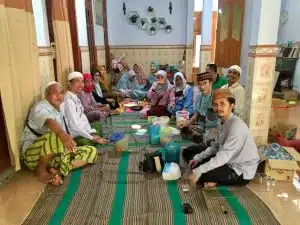
The fifth post in our alumni profile series for the 20th year of AIMEP is about Ienas Tsuroiya, a storyteller, advocate for women’s empowerment, and a 2003 AIMEP alumna.
Read her story below:
Ienas Tsuroiya
I was born in Rembang, a small town in Central Java, and raised in a pesantren (Islamic boarding school) called Raudlatut Tholibinin. The pesantren was founded by my grandfather and after he passed away, my father and his brothers continued to run it. But even though I was brought up in a very religious environment, my father was very tolerant and taught me to respect everyone. As a result, it was natural for me to have friends in our small town who were not Muslim. We all played together, and our different faiths were not a big deal.

But at university, I was looked down on for this. People used to ask me, “Why are you friendly with Christians? Why don’t you stick to Muslim friends?” So I would ask them, “Why are you forbidding me from being friends with people from other faiths? My father never had any problem with it.” And after this they left me alone.
There is a proverb in Indonesian: “tak kenal maka tak sayang”, which means, “If you don’t know someone, it is impossible to love them.” I think this is a way to explain why, even though religious freedom is protected by the Indonesian Constitution, members of religious minorities have been increasingly subjected to discrimination. In my opinion, that’s not the way it’s supposed to be. I think that dialogue between people of different backgrounds is a very important way to build a bridge.
I met my husband through a friend. He’s an activist, and his main interest is communication between people of different religions, as he believes that interfaith dialogue is very important to the peace of society. So we were a good match!
I studied French Literature, and while I was still in college, I became a middle school English teacher at a pesantren. After we got married, my husband told me that he didn’t mind if I continued to work. But not long after, our first child arrived, and I decided that I would stop to focus on my children.

However, I joined an organisation called Fatayat Nahdlatul Ulama. This organisation empowers young women through various activities such as training, workshops and discussions, and it was through my work there that I became a participant in the AIMEP program.
Coming to Australia was very interesting for me. I was surprised to see that in Australia women attend Friday prayers, because in Indonesia, only men go to the mosque. So it was a great experience for me to be able to go to Friday prayers and to hear the call to worship there.
Another thing that I appreciated was meeting people from many different backgrounds. One of my best experiences was when we went to a school and had a discussion with the children there, who were very interested to hear about Indonesia. This discussion and others like it really broadened my vision, and helped me to understand other cultures and religions better.
My husband and I both come from similar backgrounds where we grew up reciting sacred texts. So for Ramadan in 2017, he decided to recite the classical book called Ihya’ Ulumuddin, a devotional work from Imam Al Ghazali which has been translated into many different languages.
When we started, he asked me, “Do you mind if I continue reciting and you can study?” I agreed but said, “I don’t want to be alone because I might fall asleep.” Back then, Facebook had just started live-streaming, and so I asked him, “Can we do it online?” And he agreed.
As he recited the text, he translated it, word by word, as we used to do in the pesantren. And after that, he would explain the meaning. The first group of people who watched him had also studied in a pesantren, so they were kind of nostalgic about recreating how things were when they were younger. But then gradually people who didn’t know anything about the pesantren and even people from different religions joined in, because the chapter that my husband started off reading was not about religious practice, but about how to cleanse your heart from hatred.
That was very topical because at that time there was an election coming up and people from both sides were getting involved in negative social media comments. So our program came at the right time, and people were so enthusiastic that when Ramadan was over, they asked us to continue, which really surprised us.
After that, we made the program once a week rather than every day, live-streaming every Thursday night at 8pm Indonesia time. And we are still going now, 6 years later! My job is to be the camera operator. For the first few years I just used a regular smartphone, but then some of our followers helped me to get a real camera. And now we have made a room in our house into a kind of studio, and we have a laptop, so we can stream on YouTube and Facebook at the same time. Our system isn’t that sophisticated, but it’s better than when we started off!

My husband has now recited several different classical Arabic texts by various authors, and we are being followed on Facebook and YouTube by about 100,000 people. We are also live-streaming audio only on Twitter. The program is called Ngaji Online, but the people who watch regularly call themselves ‘santri online’, because students in the pesantren are often called ‘santris’.
Now my husband is invited to lead discussions and seminars on and off-campus in other cities. Often when he goes to these events, his fans who live in the area ask him to address other meetings, to recite in person the pieces that they have witnessed online. There’s often a lot of organisation to make these events run smoothly, and I’m the one who does that. As a result, everybody calls me Mbak Admin, because of my position as the woman doing everything behind the scenes! So far, we’ve been to Belgium, Boston, and even South Korea, where my husband recited in a big stadium to the many Indonesian migrant workers who live there.
Our two sons are grown up now, so my husband and I are free to go anywhere. I love travelling. I like writing too, and have just published a book about my journeys with my husband, how it all started and how it gradually got bigger. It’s called Mbak Admin’s Notes: Traveling around Nusantara with Imam Al-Ghazali.
I hope we can continue for a long time to come.

Ienas Tsuroiya
Rembang, Central Java, Indonesia
AIMEP 2003
Photographer: Ferry Yanuar