The eighth post in our Celebrating Alumni profile series features Irfan Amalee, a 2006 AIMEP alumnus and socio-entrepreneur who is passionate about promoting peace education for youth across Southeast Asia.
Read his story below:
Irfan Amalee
Although all my older brothers were sent to public schools with the hope that they would become engineers, doctors or civil servants, my father had always had a dream that one of his children would become a Kiai, a cleric or religious leader, so when I was 13, I was sent to a pesantren (Islamic boarding school).

I was brought up in an area of Bandung where people are from diverse ethnicities, including from China, Batak, Minang, Java, and Flores, like a mini Indonesia! But as a child, I didn’t notice that my friends were different – I only knew that they were human. As a result, life in the pesantren was a big change for me, as I went from a very diverse community to a completely homogeneous community, consisting only of Muslim boys from a single Muslim group, the Muhammadiyah.
At the pesantren, I began to read magazines published by ultra-conservative Muslim groups, and in my history classes, I learned about the persecution of Muslims by Spanish Christians during medieval times. Slowly, I began to hate other religious groups, especially Christians. In the language of today, you could say that I became self-radicalised, and as a result, I became more and more intolerant.

At the same time, I became interested in publishing, and started the first school magazine in the Garut district of West Java. I laid it out using Windows software, which was not available in Garut at that time, so I had to go to another city to get it published! I also became very involved in the Muhammadiyah Student Association.
When I graduated, I studied theology at the Islamic State University in Bandung, in line with my father’s expectation that I would become a kiai. But at the same time, I continued my interest in writing, and published a student newspaper which was critical of the Suharto government policies, and which was eventually banned by the university.
While at university, I was elected to the national board of Muhammadiyah. As a result, I was one of two delegates sent to a two-week Youth Camp for Peace in Cambodia organised by the Association of South-East Asian Nations. This was an eye-opening and life changing experience for me. I had learned to hate people of other faiths, but there I met people from the Baha’i, Buddhist and Christian faiths, as well as people from different nations and different ethnicities. And as the camp was held in a Buddhist temple, every morning all the participants joined the Buddhist monks for meditation. All of a sudden, I felt myself taken back to my childhood roots, when I had friends from diverse backgrounds.
One powerful part of the program was when participants told us about their experiences of war in Vietnam and Cambodia, and how they had since had a vision of peace for all young people. This really inspired me, and when I went back to Indonesia, I started a non-violent movement, inspired by the ideas of Mahatma Gandhi and Gene Sharp.

At that time, in 1998, President Suharto had just stepped down after 32 years in power, and so there was much disorder in Indonesia, including riots, ethnic conflict, and violence. Many of the people involved in violent protests felt that their actions were justified in order to obtain political power. So one of the first things I did was to visit ten cities in Indonesia to promote the idea of non-violent protest. With financial support from the The Asia Foundation, I also started a comic book with creative ideas about non-violent protest. This was published in Hai, the most popular Indonesian youth magazine at that time.
Next, I applied for the post of editor at Mizan, one of the largest Muslim publishers in Indonesia. At the time, I had not even received my degree certificate, and, of course, my degree was in theology not in journalism. But I attached a selection of my writings to my application, and even though more than one hundred people had applied for this position, I was successful!
In the same year, I was accepted to be a participant in the Australia-Indonesia Muslim Exchange Programme (AIMEP), which was very useful for me for two reasons. Firstly, I met Sheikh Abdallah, a very prominent professor with strong views about non-violence and peaceful resolution of conflict. Although he is Palestinian, he has very balanced views about how to deal with the Israeli / Palestinian conflict. He pointed out that we often get trapped in our prejudices and hatred towards other groups, and that conflict is often more complex than simply religion and ethnicity.
I also came into contact with ICED, the Islamic Centre for Educational Development, which aims to support young people who are at risk of being radicalised or involved in crime. I was inspired by their work, and later, this organisation was one of the sponsors of my first book about peace.

Over the course of the next five years at Mizan, I was promoted from junior editor, to senior editor, to general manager, and finally I became the youngest chief executive officer of my division in 2006 when I was 29 years old.
One of the things I did was to organise English classes for the employees of my unit with a Christian American teacher named Erik Lincoln. When Erik asked us what we thought about the world, I told him rudely, “The situation of the world is not good because of your country, America!” Erik was really offended, and looking at my beard, he thought to himself, “Wow, there is a Taliban in my class!”
So for some time, Erik and I were not on good terms. But gradually we began to communicate and soon realised that we had much in common, including an interest in peace education. As a result, we decided to start a Corporate Social Responsibility program within Mizan called Peace Generation.
We agreed that if we wanted to promote peace, we had to start with children and so our first project was to collaborate in writing very simple modules for teaching peace to young people. Between 2006 and 2007 we produced the first modules of Peace Generation, a comic book which includes twelve basic theories of peace.

We never expected that our book would be used very widely. But surprisingly, it was implemented by UNICEF, and then endorsed by the government, in the Aceh region, which was just recovering from the 2004 tsunami. Previous programmes about peace and non-violence had been complex and difficult to use, but all the trainers and students were happy with our book, which was very colourful and simple.
In 2009, one of my friends encouraged me to enter the British Council Young Creative Entrepreneur Awards competition. I didn’t feel that I fit the criteria, but to my surprise I was the prize-winner, and was awarded a visit to the UK to learn about communication and entrepreneurship.
After that, I was featured in many Indonesian magazines and newspapers, and was subsequently approached by the Canadian Embassy and the Indonesian Ministry of Education. I was also awarded the Ford Fellowship to do an MA in Coexistence and Conflict Studies in the US. Finally, in 2017, I resigned from Mizan to become a full-time entrepreneur focusing on running Peace Generation as an independent organisation.
At first, we concentrated on the prevention of bullying and violence in schools. However, in the past five or six years, Indonesia has experienced radicalization of many young people who end up joining groups such as ISIS. Domestic terrorist groups are also growing rapidly in Indonesia, leading to suicide bombings. Of course, this is not just a problem in Indonesia – intolerance and radicalisation is a global situation.
Indonesia is doing its best to respond to these issues. There is a National Agency for Countering Terrorism and there are also laws against violent extremism. The government also runs campaigns to make young people aware of the dangers in violent extremist views.
For our part, Peace Generation has developed a board game which teaches young people about critical thinking, and aims to encourage collaboration rather than competition. We also have a three-day training programme, supported by UNDP, where we invite former terrorists and their victims to trigger discussions about how we can increase critical thinking and empathy among people who have formerly been intolerant. Our program has now been adopted by the Indonesian government and we are assisting work by the Ministries of Education and Religious Affairs.

After 15 years, the Peace Generation program has reached 150,000 beneficiaries all over Indonesia, Malaysia, the Philippines, and Thailand, and has grown to become a social enterprise with hundreds of trainers throughout Southeast Asia.
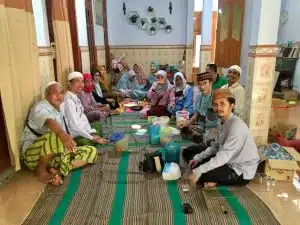
Before my father passed away, he founded a school, and eventually asked me to come and provide peace training to his staff. And in 2018, I fulfilled his expectation of becoming a Kiai by starting a pesantren of my own. Currently, it has 120 students from all over Indonesia, and because of its uniqueness, it has been visited by many researchers and education enthusiasts.
Since the school emphasises teaching the peace values of Islam, instead of ‘pesantren’, we call it PeaceSantren.
Irfan Amalee
Bandung, Indonesia
AIMEP 2006
Photo credits: Ferry Yanuar and Irfan Amalee/Peace Generation