The ninth post in our Celebrating Alumni profile series features Dr Mahsheed Ansari, a 2007 AIMEP alumna and Islamic studies scholar at Charles Sturt University.
Read her story below:
Mahsheed Ansari
I was born in Kabul in the midst of a lot of chaos and trouble. After the Soviet invasion, the country was left in civil war, and when I was four years old, my family decided to leave with me and my three siblings. My parents really fought against all the odds to get out of Afghanistan because of the vision they had for us children to have an education. Of course, at this moment, girls can’t go to school in Afghanistan.

We first lived in Delhi as refugees for several years. I have some wonderful childhood memories from India. Our environment there was very multicultural – for example, some of our neighbours were Armenian Orthodox Christians and others were Nigerian. We also had Punjabi and Sikh landlords and neighbours.
I was nine when we were accepted to come to Australia. At first, I was really looking forward to coming because we would be reunited with our grandparents and cousins who were already here. But life in Australia was initially quite challenging. I had to first learn the language properly, and change primary schools twice. Then, when I got to high school, I had to adapt to another new group of friends.

I started to question my identity perhaps a bit earlier than other young people. As a young person you want to belong, and you worry that because you look different, you might be different. My family had always practised Islam, but when we came to Australia, my siblings and I became more deeply committed to our faith as part of our search for who we really were. And it was my faith that finally gave me inner peace and confidence.
Next, I went to university to read law, as my father thought it was the right thing for me to study. In those days, I was involved in a lot of interfaith activities, and it was through these that I was accepted into the AIMEP.

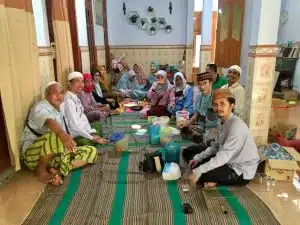
I loved travelling, but hadn’t left Australia ever since I arrived as a child, so it was a wonderful experience for me to go to Indonesia. I’m a person with more interest in the human side so my highlight was visiting a village pesantren (boarding school) and staying in the village with these amazing warm people. I thought their expression of Islam was beautiful, and it really made me appreciate the variety of Islamic spirituality.
We were staying in a five-star hotel, but right next to the hotel were these shanties, which was a stark contrast. However, in spite of the poverty, people were always smiling. And I realised that back home, where life was much easier, my friends and I weren’t always smiling. Another experience that I remember was when one of the professors took us to his mother’s house for breakfast. She was living in a simple hut but was so hospitable with all the food she had made, and this made me resolve to try to keep a perspective of what real life is about.

After graduating, I did work briefly in the law field. However, I didn’t last long, because I soon decided to go back to university to read Arabic and Islamic studies at Master’s and doctorate level.
I’m now a senior lecturer in Islamic studies at Charles Sturt University, teaching Islamic spirituality, world religions, and the history of Muslims in Australia. Sometimes we host AIMEP groups at the university here, and I very much enjoy being able to give back to the program. I have seen a real change, not just in myself but in other groups of leaders who participate – an appreciation for other cultures and also a strength in their own tradition. And it’s a great way to connect people. I think the ego likes to distinguish and separate, but deep down our spirit calls us to something greater.
I believe we are created to live purposefully and meaningfully, and that belief and spirituality help human beings to make sense of their lives and create inner peace. We’re just coming into Ramadan, a time of reflection and retreat. And I’ve been thinking about the importance of appreciating wherever we are in life, despite the constant changes, and about how important it is to always be mindful, and to keep connecting with and realigning ourselves with our core, our soul.

Mahsheed Ansari
Sydney, Australia
AIMEP 2007